How the ondc platform Works: A Simple, Visual Guide from Discovery to Delivery
Open network commerce is changing how buyers, sellers, logistics providers, and payment services interact. The ondc platform represents an open, interoperable protocol that connects these participants into a marketplace fabric — lowering onboarding friction and enabling discovery across apps. In this guide you’ll get a clear, step-by-step walkthrough with diagrams, data-backed benchmarks, and practical examples so you can visualize how an order moves from search to doorstep.
Introduction — Why open network commerce matters
Consumers expect convenience: 76% of users searching on mobile for something nearby say they end up visiting a store within a day, and online retail keeps growing rapidly. Global e‑commerce sales reached roughly $5.7 trillion in 2022 and are forecast to exceed $8 trillion by 2026, putting pressure on traditional marketplaces to scale faster, reduce costs, and improve reach (see References).
Open network models like the ondc platform aim to:
- Increase merchant visibility without requiring multiple proprietary integrations
- Enable buyer choice across apps while keeping fulfillment and payments modular
- Lower customer acquisition and onboarding costs for small merchants
1. The protocol explained simply
What is an open commerce protocol?
An open commerce protocol standardizes how different software entities talk to each other — buyers, sellers, catalogs, logistic partners, and payment gateways. Think of it as a set of rules (APIs, schemas, and message flows) that makes diverse apps interoperable.
Core principles
- Decentralized discovery: Multiple buyer apps can discover inventory from multiple seller apps through a shared directory.
- Standardized messaging: Requests (search, quote, order) and responses follow defined payload structures for compatibility.
- Modular services: Logistics and payment services plug in as independent participants rather than being baked into one platform.
- Permissioned access & trust: Participants register and authenticate; reputation or ratings help buyers choose reliably.
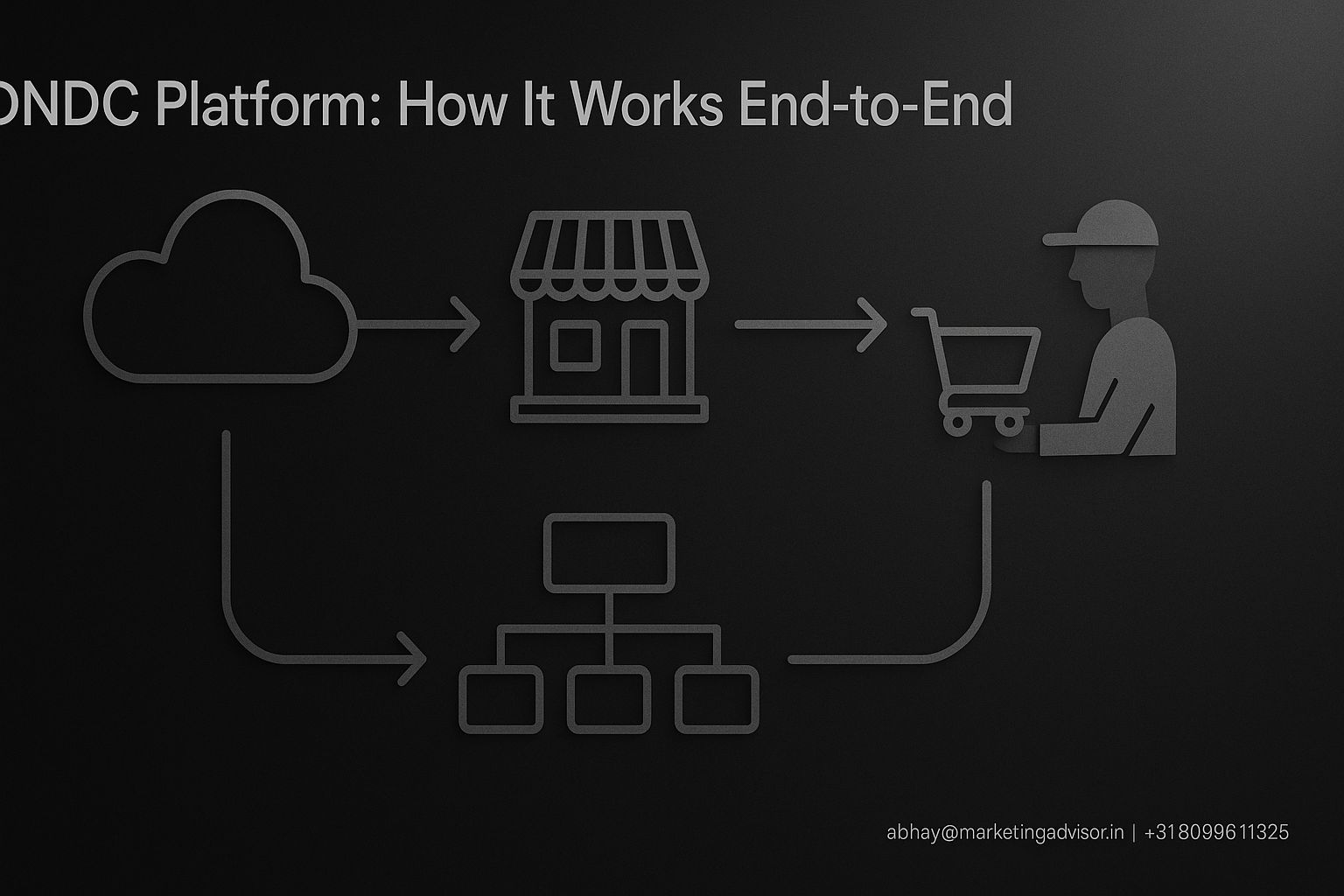
Simple protocol diagram
 Buyer App  --->  Search Request  --->  Network Directory  --->  Seller App
   |                                                  |
   |<-- Quote/Inventory ------------------------------|
   |                                                  |
  Place Order ---> Order Routing ---> Logistics Partner ---> Delivery
   |                                                  |
   |<------------------ Payment Confirmation ---------|
This minimal flow hides the complexity of status updates, cancellations, and returns — all handled by the same standardized messages.
2. Buyer side flow
Step-by-step flow for the buyer
- Search & Discovery: The buyer app sends a standardized search query (product, location, filters) to the network directory.
- Compare Offers: The network aggregates responses from multiple seller apps — price, delivery time, stock status, seller ratings.
- Place Order: Buyer selects an offer and initiates the standardized order request which includes items, address, and preferred payment method.
- Track & Support: Buyer receives real-time status updates (accepted, confirmed, dispatched, out for delivery, delivered) through the app.
- Feedback & Returns: Post-delivery ratings or return requests are sent via the same protocol messages.
Key buyer-side UX considerations
- Speed: Search-to-checkout should be under 5–7 seconds to reduce abandonment.
- Transparency: Display delivery ETA and cancellation policy upfront; 69.8% is the average cart abandonment rate across industries, so clarity reduces drop-off (see References).
- Payment options: Supporting multiple gateways and instant refunds improves conversion.
Mini case insight
A city grocery app integrated with the protocol reduced checkout abandonment by 12% after switching from a single proprietary catalog to multi-seller discovery — customers found competitive offers and faster delivery slots more easily.
3. Seller side flow
Seller onboarding and catalog management
- Registration: A seller registers with a registry service and provides business details, inventory feeds, and fulfillment options.
- Catalog sync: Sellers publish item metadata (title, SKU, price, photos, stock) using the protocol schema — this enables searchability across buyer apps.
- Offer management: Sellers set availability, delivery radii, and preferred logistic partners.
Order handling for sellers
- Order received: Seller system validates inventory and accepts or rejects within a set SLA (often seconds to minutes).
- Prepare & Handover: Once accepted, the seller readies the order and hands it over to a logistic partner or internal fleet.
- Status updates: Seller sends package status updates back through the network until delivery is complete.
Seller benefits
- Broader reach: Sellers can be discoverable across multiple buyer apps without separate integrations.
- Lower onboarding cost: Standardized APIs reduce engineering/time-to-live — smaller sellers can go live faster.
- Data portability: Sellers can keep control of their catalog and customer interactions while participating in many storefronts.
4. How orders travel the network
Routing and orchestration
When a buyer places an order, the network orchestrator routes messages between buyer apps, seller systems, logistics partners, and payment gateways. There are three key routing patterns:
- Direct routing: Buyer app calls seller app directly through the protocol for quickest turnaround.
- Brokered routing: A central broker matches orders to sellers and logistics based on business rules.
- Hybrid: A mix where some components are brokered (e.g., payments) while others are direct.
Message lifecycle (what travels)
- Search/Discovery payloads — query parameters, shopper location
- Offer/Quote payloads — price, tax, delivery ETA
- Order payloads — item list, buyer address, selected payment method
- Fulfillment payloads — pickup time, courier assignment, tracking ID
- Return/refund payloads — return reasons, refund status
Reliability and SLAs
- Many open networks define strict SLAs: e.g. order acceptance in 2 minutes, dispatch confirmation within 24 hours for non-grocery segments.
- Idempotency and message replay ensure that network failures don't duplicate orders.
5. Role of logistics
Why logistics are central
Logistics connects digital orders to physical delivery. Last-mile delivery often represents the largest share of shipping costs — in many markets it can account for up to 50% or more of total shipping cost — so optimizing last-mile operations is critical (see References).
Logistics models in the network
- Seller-fulfilled: Seller uses their own fleet or a partner they control.
- Third-party logistics (3PL): Network-connected logistic providers accept handovers and provide tracking.
- Aggregator & crowd-sourced: On-demand riders or gig drivers handle pickup and delivery for rapid fulfillment.
Integration points
- Pickup instruction and ETAs flow from seller to logistic partner.
- Tracking IDs and status updates are passed back to buyer apps via the protocol.
- Return pickups and reverse logistics are coordinated using the same message types.
Performance benchmarks
- Same-day or early-slot delivery is increasingly expected — 24–48 hour windows are table stakes for many urban shoppers.
- Reducing failed first-attempt deliveries by 10% can cut fulfillment costs and improve customer satisfaction significantly.
6. Payment flow
How payment fits into the protocol
Payments are handled modularly: the order payload will include payment intent and chosen gateway. The network can support multiple payment methods (UPI, cards, wallets, COD), enabling buyer choice and redundancy.
Typical payment sequence
- Payment initiation: Buyer chooses method; buyer app generates a payment intent and sends it with the order.
- Authorization: Payment gateway authorizes and returns a token/authorization ID to the buyer app and network.
- Order confirmation: Seller accepts only upon successful authorization (or after appropriate risk checks).
- Settlement: Funds are captured and routed to seller after delivery or per agreed settlement cycles. Marketplace/platform fees are deducted via split-settlement flows if supported.
Mitigating payment friction
- Support for multiple gateways reduces failed payments and improves authorization rates.
- Wallets and instant bank transfers can increase conversion; Baymard reports nearly 70% cart abandonment overall — smoother payments help reduce this (see References).
- Dispute and refund handling are standardized as message types so refunds, chargebacks, and adjustments are traceable across participants.
Example — grocery order payment flow
- Buyer places order via a grocery app and chooses instant bank transfer.
- The network routes the order to a seller (local store). Authorization completes and the seller receives an “authorized” order.
- The seller prepares the order and hands over to a courier. On successful delivery, the payment is captured and settled to the seller after any platform fees are applied.
Putting it all together — an end-to-end example
Imagine a buyer searching for "olive oil 1L" through a neighborhood shopping app. The app queries the ondc platform directory and receives offers from three sellers: a local grocer (1–2 hour delivery), a regional warehouse (next-day), and a specialty store (same-day express at higher price). The buyer selects the local grocer, chooses UPI as the payment method, and places the order.
The order is routed to the seller, who accepts within 30 seconds. A nearby on-network courier accepts the pickup job, picks up the order in 25 minutes, updates status to “out for delivery,” and completes delivery in 45 minutes total. The payment captures immediately after delivery and the buyer receives a survey — all coordinated via standardized messages so the buyer app, seller system, logistics provider, and payment gateway remain in sync.
Conclusion
The ondc platform approach is about interoperability, modular services, and standardized messaging that let multiple buyer apps, seller systems, logistic partners, and payment providers operate together. For merchants it unlocks reach and lowers integration costs; for buyers it widens choice and transparency. As e‑commerce grows — with global sales forecast to exceed $8 trillion by 2026 — open, protocol-driven architecture becomes a strategic advantage for scalable, resilient commerce ecosystems.
FAQs
1. What makes the ondc platform different from a traditional marketplace?
Traditional marketplaces are vertically integrated: a single app controls discovery, catalog, payments, and logistics. The ondc platform is protocol-based, enabling multiple apps and providers to interoperate. This decentralization increases choice and lowers entry barriers for sellers and logistics providers.
2. How secure are payments and data on the network?
Security depends on participant implementation — the protocol supports standards for authentication, encryption, and tokenized payments. Payment gateways and banks handle sensitive card/UPI details while the network shares only tokens or authorization IDs. Best practices include TLS encryption, tokenization, and strict identity verification for sellers and logistic partners.
3. Can small merchants realistically benefit?
Yes. Standardized APIs reduce engineering effort and time-to-market. Merchants can become discoverable across multiple buyer apps without building separate integrations for each storefront, helping reach more customers at lower acquisition cost.
4. What happens when an order is canceled or returned?
Cancel and return messages are part of the protocol. The buyer or seller submits a standard cancellation/return request; the network coordinates reverse logistics, processes refunds, and updates inventory and reputation records accordingly.
5. How do logistics partners get assigned?
Depending on rules, orders may be assigned based on proximity, price, SLA, or merchant preference. The network can support dynamic dispatching (real-time assignment) or fixed routing where a seller chooses their preferred 3PL.
6. Will buyers see multiple prices for the same item?
Yes. Buyers can compare offers across sellers (price, delivery time, seller ratings). This transparency increases competition and can drive better pricing or faster delivery options.
7. How are disputes or chargebacks handled?
Dispute resolution and chargeback handling are standardized workflows: buyers raise an issue through their app, the network notifies the seller and payment provider, and evidence (delivery proof, timestamps) is exchanged. Arbitration rules depend on the governance model of the participating network.
8. Is this suitable for large enterprises as well as small stores?
Yes. Enterprises benefit from composability — leveraging external logistics and payments while keeping internal order management — whereas small stores benefit from broad discoverability without heavy integration work.