How Payments and Settlements Work on an ondc seller platform
Running a successful ondc seller platform presence means more than listing products — it requires a clear understanding of payment flows, settlement timing, reconciliation and tax handling. With real-time rails like UPI handling tens of billions of transactions monthly and global e‑commerce sales topping trillions of dollars, sellers who master payments get faster cash conversion and fewer disputes. This guide breaks down payment flow, UPI integration, T+1 vs T+2 settlement trade-offs, reconciliation best practices, dispute handling, and tax deduction points every ondc seller platform merchant should know.
Payment flow overview
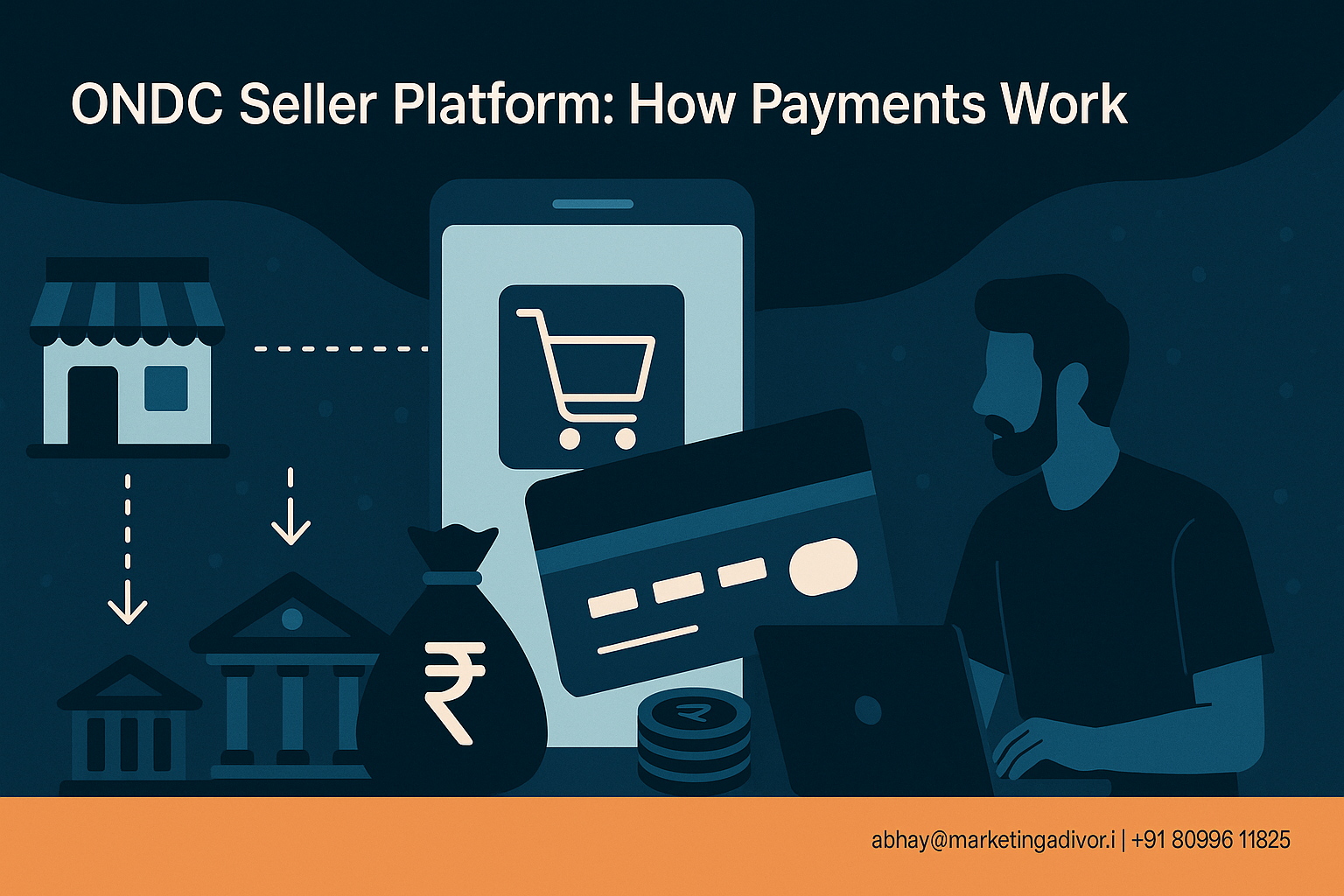
At its simplest, the payment flow on an ondc seller platform moves money from buyer to seller via an acquiring/payment gateway and a settlement network. Breaking the process into clear stages helps identify where delays, fees, or reconciliation mismatches happen.
Key stages in the payment flow
- Customer Checkout: Buyer initiates payment (UPI, card, wallet).
- Authorization: Payment network authenticates and authorizes the transaction in real time (seconds for UPI, seconds–minutes for cards depending on 3DS).
- Capture & Confirmation: Transaction is captured and the buyer sees confirmation. Platform updates order status.
- Settlement Instruction: The gateway/acquirer batches settlement instructions for the seller account.
- Clearing & Settlement: The payment network clears funds between banks/payment processors and credit the seller’s ledger.
- Payout to Bank: The gateway processes a payout to the seller bank account (T+0/T+1/T+2 depending on agreement).
Why understanding each step matters for ondc seller platform merchants
- Cash flow forecasting — settlement cycles determine when you can reinvest or pay suppliers.
- Fee visibility — each stage may include fees (gateway fee, merchant discount rate, platform commission).
- Reconciliation — timestamps and identifiers at each stage are used to match payouts to transactions.
- Dispute readiness — knowing where chargebacks or UPI reversal flows occur helps resolve issues quickly.
Industry context: UPI and similar real-time rails are the backbone for many seller platforms. Real-time settlement expectations are rising — according to payment industry analyses, consumers and merchants increasingly expect faster payouts and clearer settlements as digital commerce scales (see References).
UPI integration for ondc seller platform sellers
UPI is the dominant real‑time retail payment instrument in many markets that support it. For ondc seller platform merchants wanting fast, low-cost payments, integrating UPI is often essential.
Technical integration options
- Direct NPCI/Bank integration — complex, requires bank onboarding, recommended for large merchants with volume.
- Payment gateway integration — quickest route: gateway exposes UPI QR, deep links and callback APIs.
- Third‑party SDKs and plugins — for marketplaces or platforms that need plug‑and‑play UPI flows embedded in web and mobile apps.
Practical checklist for UPI integration
- Support for deep links and collect requests (for in‑app seamless flow).
- Implement one‑time and recurring payment flows if offering subscriptions or EMIs.
- Webhooks and callback URLs for immediate confirmation to your order system.
- Robust timeout and retry logic to handle network or bank latency.
- Clear UX — display payer VPA, amount and purpose to reduce failed transactions and disputes.
Data point: UPI processes tens of billions of transactions every month, making it a proven rail for scale and cost efficiency (see NPCI statistics in References). For sellers, UPI success rates and instant confirmation drastically reduce payment uncertainty compared with slower settlement rails.
Settlement: T+1 vs T+2 — which is right for your ondc seller platform business?
Settlement cycle (the time between capture and when funds land in your bank) materially impacts working capital. Two common cycles are T+1 (next-day settlement) and T+2 (two business days). Some providers also offer same‑day or T+0 at an additional cost.
Comparing T+1 and T+2
- Cash conversion speed: T+1 reduces float by one business day compared with T+2 — faster access to capital.
- Cost: Faster payouts often carry a higher fee (a small percentage or flat charge per payout).
- Risk: Shorter settlement windows can increase reversal risk exposure for the processor; underwriting or holds may be used to mitigate that.
- Operational complexity: T+1 requires more immediate reconciliation and faster dispute resolution workflows.
When to choose T+1
- If your business has tight working capital and needs quick inventory replenishment.
- If average order values are small but volume is high (fast cash cycle matters).
- If your margin can absorb the incremental payout fee.
When T+2 may be acceptable
- Lower-volume sellers where fee savings outweigh faster access to funds.
- Businesses with predictable cash flow and long supplier payment terms.
Example: A grocery seller processing ₹1 million/month with a 0.2% extra fee for T+1 would pay an additional ₹2,000 for faster access — a cost many merchants offset through faster inventory turnover and fewer stockouts.
Reconciliation best practices for ondc seller platform accounting
Accurate reconciliation prevents revenue leakage and simplifies tax reporting. As marketplaces grow, automated reconciliation is a competitive advantage.
Core reconciliation steps
- Collect raw transactional records: gateway reports, bank statements, platform commission ledgers.
- Match transactions using unique IDs, timestamps and amounts.
- Account for fees, refunds, chargebacks, GST/VAT and platform commissions.
- Identify and investigate mismatches fast (daily or hourly matching reduces backlog).
Automation and tools
- Use accounting integrations (Xero, QuickBooks) or an ERP with API ingestion of gateway reports.
- Leverage reconciliation engines that auto‑match >95% of transactions and flag exceptions.
- Maintain an exceptions queue with SLA targets (e.g., resolve within 48–72 hours).
Industry benchmark: Efficient merchant operations aim for >99% auto‑reconciliation and resolve exceptions within 72 hours to avoid settlement drift and reporting errors.
Common reconciliation pitfalls
- Mismatched timestamps due to time zones or batch settlement times.
- Fee treatment differences: gross vs net settlement reporting.
- Unreconciled refunds and chargebacks if not reflected in both bank and gateway reports.
Handling disputes and chargebacks on an ondc seller platform
Disputes are inevitable. Faster, data-driven dispute management reduces losses and improves buyer trust.
Types of disputes
- Payment reversal (UPI collect failure, duplicate payment).
- Chargebacks (card transactions disputed by buyer’s bank).
- Refund requests due to non-delivery or product issues.
Best practices for dispute prevention
- Provide clear order confirmations and delivery tracking to buyers.
- Store proof of delivery (POD), customer consent messages and invoice copies.
- Implement 3D Secure for high-value card transactions when available.
- Use transaction metadata — IP, device, VPA, buyer contact — for faster validation.
Dispute resolution workflow
- Immediate acknowledgment to buyer and initiation of investigation within 24 hours.
- Gather and submit evidence to the gateway/acquirer per prescribed timelines (often 7–15 days for card chargebacks).
- Track dispute resolution in a dashboard and update accounting entries when outcomes are final.
Case insight: A mid‑sized marketplace reduced chargeback losses by 40% within six months by enforcing mandatory POD capture and automating evidence submission to acquirers.
Tax deductions, TDS and reporting for ondc seller platform merchants
Taxes and statutory deductions apply to payouts on seller platforms. Understanding when and how tax is deducted at source ensures correct net payouts and simplified compliance.
Typical tax deductions
- TDS/TCS on marketplace supplies or payments to non‑resident sellers (rules vary by jurisdiction).
- Withholding on specific payment types (e.g., advertising, affiliate commissions).
- Goods and Services Tax (GST) or VAT that may be collected at the time of sale or invoicing.
Practical tax checklist for sellers
- Keep detailed invoices for sales and platform commissions — required for input tax credit claims.
- Validate seller PAN/TIN and provide tax forms to avoid higher withholding rates.
- Monitor monthly payout statements for withheld amounts and ensure they are reflected in tax credits.
- Coordinate with the platform to get Form 26AS or equivalent records for withheld taxes.
Tip: Platforms often act as collecting agents for certain taxes and will provide annual statements to reconcile deducted TDS/TCS. Regular review prevents surprises at year-end.
Conclusion
Mastering payments and settlements on an ondc seller platform is a strategic advantage. From selecting the right UPI integration path to choosing a settlement cadence (T+1 vs T+2), automating reconciliation and handling disputes efficiently, each step improves cash flow, reduces leakage, and strengthens buyer trust. Use data-driven tools, aim for fast reconciliation SLAs, and maintain clear tax records to scale sustainably. As real-time payment rails continue to expand, sellers who optimize payments will unlock better margins and faster growth.
Frequently Asked Questions (FAQs)
1. What is the fastest way to get payouts on an ondc seller platform?
Choose providers offering T+0 or T+1 settlement. T+0 (same-day) may carry higher fees. Evaluate the trade-off between payout speed and cost relative to your working capital needs.
2. How does UPI differ from card payments for platform sellers?
UPI is real‑time and often cheaper (no interchange fees like cards). UPI confirms payments instantly, reducing reconciliation friction. Card transactions have chargeback risk and may require 3D Secure for additional authentication.
3. How should I reconcile platform statements with bank payouts?
Automate ingestion of gateway reports and bank statements, match using unique transaction IDs, account for fees and refunds, and resolve exceptions in an SLA (ideally within 72 hours).
4. What are common reasons for payment reversals?
Duplicate payments, incorrect UPI VPA, failed collect requests, expired mandates, or disputes and chargebacks lead to reversals. Immediate monitoring and robust webhook handling reduce unresolved reversals.
5. Are settlement fees negotiable on an ondc seller platform?
Yes — rates often depend on monthly volume, average ticket size, and risk profile. High-volume sellers can negotiate lower gateway fees or prefer net settlement arrangements.
6. How do refunds affect reconciliation and tax reporting?
Refunds reduce net taxable revenue and must be recorded against original invoices. Ensure refund records flow through your accounting system and are visible in monthly payout reports to claim correct tax credits.
7. What documents help resolve chargebacks faster?
Proof of delivery (POD), signed invoices, customer communications, transaction metadata (VPA, IP, device), and time-stamped order status updates are crucial evidence for disputes.
8. How frequently should I audit my payment processes?
Perform daily reconciliation for high-volume sellers and monthly financial audits that include a review of fees, reversals, disputes, and compliance with tax withholding obligations.